
In partnership with

DEAR READER,
Fifteen years ago, New Eastern Europe sent its first issue to print with cautious optimism: democratisation was underway, the post-Soviet world was finding its footing, and the direction of travel, if not the speed, seemed somewhat clear. Our latest issue asks a simple, uncomfortable question: what if none of that was as linear as it looked?
The anniversary issue is out now, and Europe is dividing again not along the old Iron Curtain, but along new fault lines of threat perception, defence spending, and democratic resilience.
Enjoy reading this week’s “brief”!
— Giorgi Beroshvili, Editor

TOP STORIES OF THE WEEK
🇵🇱 Tusk warns Russian escalation could reach Poland. Polish Prime Minister Donald Tusk has warned that Russia’s military activity is likely to intensify in the coming weeks and months and that attacks on Polish territory cannot be ruled out. His remarks came after Russian drones struck western Ukraine near the Polish border, including a passenger train at Yahodyn railway station roughly 2 kilometres from the border. No one was injured. Tusk said Russia is increasingly using more dangerous technologies, including jet-powered drones, and ordered officials to assess Poland’s preparedness for possible drone attacks or attempts to disrupt railways and businesses. Polish authorities said there had been no violation of Polish airspace, while Foreign Minister Radosław Sikorski described the incidents as an escalation and called for stronger support for Ukraine.
🇺🇦 / 🇲🇩 Zelenskyy’s flight reportedly nearly hit by drone. Norwegian Prime Minister Jonas Gahr Støre said a plane carrying Ukrainian President Volodymyr Zelenskyy from Moldova to Norway was “almost hit by a drone” on its way to Oslo for King Harald V’s funeral. A Ukrainian presidential source gave a more cautious account, saying there had been an alert after a Russian drone entered Moldovan and Romanian airspace, but described claims that Zelenskyy was directly at risk as exaggerated. Zelenskyy arrived in Oslo Tuesday and met Støre and other Norwegian officials to discuss military and civilian aid, including air defence support, before attending the funeral on Wednesday.
🇭🇷 Wildfire forces hundreds to evacuate on Croatia’s Brac island. Nearly 700 people were evacuated as a rapidly spreading wildfire threatened homes and tourist accommodation around Milna on the Adriatic island of Brac. More than 220 firefighters and 69 vehicles battled the blaze overnight, while tourist boats helped evacuate people as strong winds caused the fire to spread rapidly. Around 3,500 hectares were affected and some buildings were damaged, though no deaths were reported. Authorities said there were no active fires by Sunday morning but warned of possible reignition, with four firefighting aircraft remaining deployed.
🇷🇺 / 🇮🇳 Modi and Putin seek closer ties as BRICS challenges Western dominance. Indian Prime Minister Narendra Modi and Russian President Vladimir Putin agreed to deepen bilateral ties ahead of the BRICS summit in New Delhi, as Moscow called for the bloc to build a global economic system less dependent on Western rules. Putin accused Western countries of using sanctions, tariffs and attacks on trade and logistics infrastructure to preserve their dominance, while his envoy Kirill Dmitriev said BRICS was evolving into a more practical economic partnership focused on business, technology, investment and alternative payment systems. Modi and Putin also discussed conflicts in West Asia and the Black Sea that have disrupted maritime trade, while India continues to resist US pressure to reduce purchases of Russian oil. New Delhi is meanwhile seeking to balance its relationships with Washington, Moscow, Tehran, the Gulf states and Israel.
A MESSAGE FROM OUR PARTNER
Free email without sacrificing your privacy

Gmail is free, but you pay with your data. Proton Mail is different.
We don’t scan your messages. We don’t sell your behavior. We don’t follow you across the internet.
Proton Mail gives you full-featured, private email without surveillance or creepy profiling. It’s email that respects your time, your attention, and your boundaries.
Email doesn’t have to cost your privacy.
EXPERT OPINION
Is Europe divided again?

The East–West divide should not be overstated. Estonia, Romania and Lithuania have generally remained strongly pro-European despite placing considerable emphasis on national independence. Conversely, sovereigntist politicians in Western Europe have achieved considerable political success. Nevertheless, it is primarily in parts of Central and Eastern Europe that states increasingly resemble isolated islands, jealously guarding their borders and defending “go-it-alone” policies in an ever more interconnected and interdependent European environment.
With the fall of the Berlin Wall and the enlargement of the European Union, the East-West divide in Europe appeared to lose much of its significance. Although the Eastern Bloc was highly diverse in terms of size, culture and historical experience, the Soviet grip over its satellite states constituted a powerful unifying factor. The disintegration of the Soviet Union enabled the countries of Central and Eastern Europe to reunite with the western part of the continent, a process that culminated in their accession to the European Union two decades ago.
Admittedly, one can argue that the enlargement process merely created a new division in Europe, leaving parts of the Balkans and Eastern Europe outside the Union. Yet this new dividing line did not appear to be permanent. The European Union repeatedly expressed its intention to enlarge further eastwards and southwards while simultaneously extending its influence beyond its borders through the export of European capital, goods, laws and, more recently, military assistance. As Bill Clinton confidently declared at the Brandenburg Gate:
“Now, together, we can walk through that gateway to our destiny, to a Europe united, united in peace, united in freedom, united in progress for the first time in history. Nothing will stop us. All things are possible. Berlin is free.”
The title of this journal, New Eastern Europe, founded 15 years ago, could therefore be seen as symbolizing Eastern Europe’s return to its western home: a new Eastern Europe emerging after decades of violence, authoritarianism, and isolation that had characterized much of the region throughout the 20th century.
Today, however, this vision appears increasingly outdated, if not altogether naïve. War has returned to Eastern Europe, democratic institutions are under growing strain, and new walls are being erected. As in the past, Russia bears primary responsibility for these developments. Yet much of the damage to the idea of “a Europe whole and free” is also inflicted by domestic political actors campaigning under the slogan of “our nation and state first!” Across much of the continent, and particularly in Central and Eastern Europe, war, nationalism and sovereigntist outlooks are once again driving Europe apart.
The politics of fear
It is often argued that Russia’s full-scale invasion of Ukraine in 2022 united and mobilized the EU and its member states. The invasion was met with a swift and decisive response from the EU, which imposed sanctions on Russia, coordinated various forms of assistance to besieged Ukraine, and strengthened its own defence efforts both within and beyond NATO. Yet perceptions of security threats differ markedly between states bordering Ukraine or Russia and those located further south and west. A Pew survey conducted in 2025 showed that around three-quarters of Poles regard Russia as the principal threat, while only about one-third of Italians and Spaniards share this view. In Greece, Turkey rather than Russia is perceived as the principal threat. Among Spaniards, the United States is regarded as posing as serious a threat as Russia.
The nature of these concerns also differs, as demonstrated by an ECFR poll conducted in 2022. Poles are primarily concerned about the possibility of Russian military action and refugee flows. Respondents in Finland, France and Romania expressed particular concern about disruptions to energy supplies and the economic consequences of the war, while cyber-attacks ranked among the dominant concerns in Sweden and France. The ECFR poll also found that respondents in Poland, Romania and Sweden were considerably more willing to make economic sacrifices than those in France and Germany.
Threat perceptions are also reflected in levels of military spending. According to NATO estimates for 2025, Poland currently spends no less than 4.5 per cent of its GDP on defence. The three Baltic states bordering Russia – Latvia, Estonia and Lithuania – each spend more than three per cent of GDP. By contrast, the lowest spenders remain Ireland (0.22 per cent), Malta (0.45 per cent), Luxembourg (0.85 per cent), and Austria (1.10 per cent).
Statistics aside, the most striking difference between the states of Central and Eastern Europe bordering Russia and those located further south and west concerns the prevailing pattern of politics. An outside observer cannot fail to notice that politicians in Poland and the three Baltic states increasingly speak and act as if their countries were already in a state of war with Russia. First, one observes a pervasive sense of wartime anxiety, even though no full-scale war is taking place on their territory and the prospect of one remains hypothetical. Second, external threats are increasingly invoked to legitimize extraordinary measures, including some that appear difficult to reconcile with the principles of liberal democracy. Third, growing hostility is directed by self-proclaimed patriots against alleged “traitors”. Fourth, security considerations increasingly shape socio-economic policy. Fifth, there is a growing conviction that only a strong leader can guide the nation to victory.
Needless to say, these developments have adverse consequences for the quality of democracy, the protection of human rights, media independence, and sound economic governance. Paradoxically, the political responses adopted by those states that fear Russia most may gradually bring certain features of their political and economic systems closer to those of Russia – not by design, but as an unintended consequence of prolonged insecurity. This does not mean that a new Eastern Bloc is emerging. The countries of the region continue to display diverse threat perceptions and political responses. Sweden, for example, shares many of Poland’s security concerns, while Hungary has often portrayed Ukraine as posing a greater threat than Russia. There is little doubt, however, that since Russia’s invasion of Ukraine geography and history have once again become important factors shaping new patterns of convergence and divergence within the EU.
— Jan Zielonka, emeritus professor of European Politics at the University of Oxford

Fifteen years ago, when we sent the first issue of this magazine to print and later – thanks to our international distributor – to bookshops around the world, our thinking about political developments was still quite linear.
Although, like many scholars and political observers, we were cautious about embracing Francis Fukuyama’s claim about the “end of history”, we nonetheless believed that democratization was underway. At the same time, it was already clear that what is generally described as the post-Soviet transformation differed significantly from what had taken place in Central Europe, and that the region still faced its own set of challenges.
Today, in the autumn of 2026, we can see that such linear thinking is no longer applicable.
ARTICLES OF THE WEEK

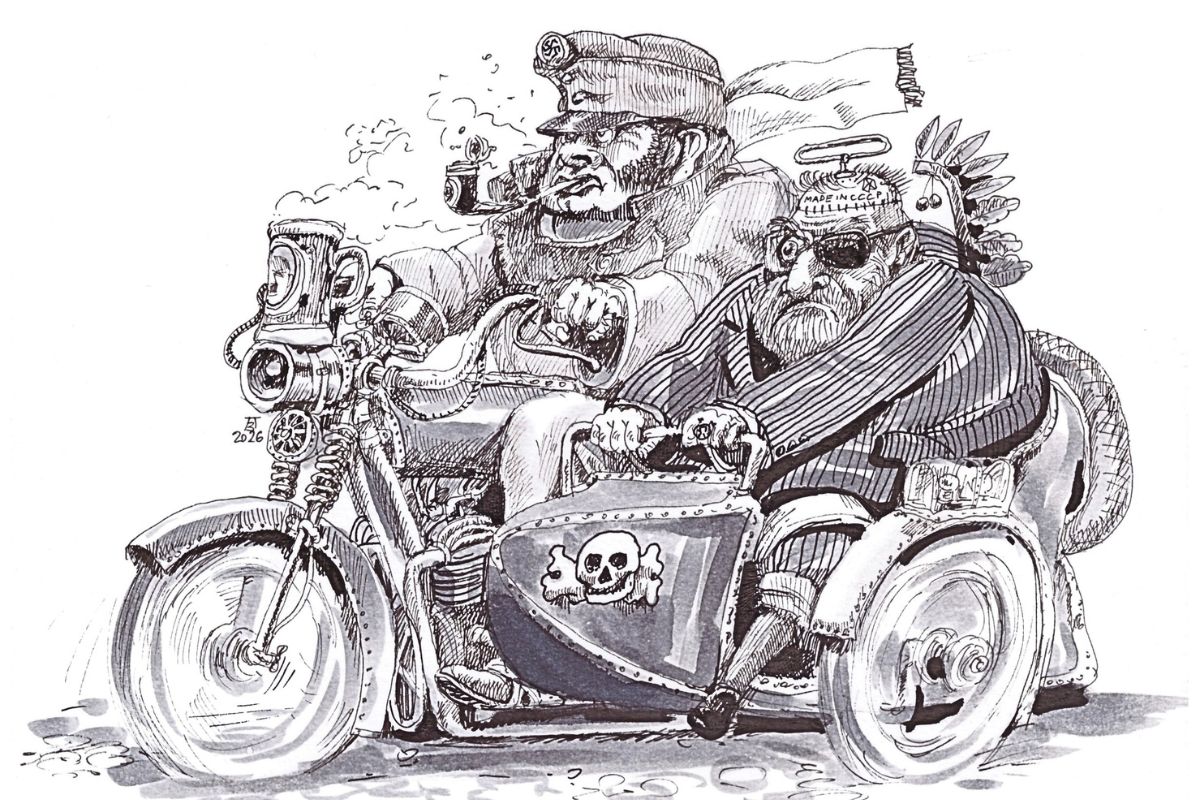

CARTOON OF THE WEEK

Do you want to see more of Andrzej’s drawings? Check out our dedicated gallery page featuring his cartoons here.