
In partnership with

DEAR READER,
What do Taylor Swift, Autocracy, Inc., and Talk Eastern Europe have in common. According to our Spotify Wrapped… the same audience.
TEE listeners clocked 145,000 minutes with us this year (roughly 100 days of nonstop listening!), with the US, Poland and the UK leading the charts. Our podcast team is genuinely grateful, thank you for sticking with us.
And since we are on the topic of year-end milestones, we are this 🤏 close to another big one. New Eastern Europe is just 25 memberships away from reaching 400 paid members. If you have been thinking about joining, now is the ideal moment: our newest issue, Remembering yesterday, today, has just been released. Grab your copy to make sure it lands in your mailbox before our Christmas break — and help us hit that benchmark.
Plus, if you know someone who’d love a gift subscription, you can surprise them by following this link.
As for our expert opinion: we are heading to Bulgaria. Last week, nearly 100,000 people filled the central square in Sofia to protest against the current coalition government, with similar demonstrations breaking out in Plovdiv, Varna, Burgas, and towns across the country. We asked Aleksandar Malinov to walk us through what’s really happening.
Enjoy reading this week’s “brief”!
— Giorgi Beroshvili, Editor

Episode 247: When music defies power. The case of Belarus. Guest: Peter Vermeersch
TOP STORIES OF THE WEEK
🇺🇦 Zelenskyy-Trump envoys discuss territorial concessions and security guarantees in sensitive call. A recent call between President Volodymyr Zelenskyy and US envoys Steve Witkoff and Jared Kushner touched on the most delicate issues of the ongoing peace talks, including potential territorial concessions and long-term security guarantees, Axios reported. Moscow is said to be insisting Kyiv withdraw from remaining parts of Donetsk Oblast, while US negotiators are exploring alternative proposals to narrow the gap. Sources told Axios Washington and Kyiv have made significant progress on security guarantees but still need to ensure they interpret the terms identically. Ukraine’s ambassador in Washington, Olha Stefanishyna, said negotiators aim for solutions that are “realistic, fair, and sustainable”. Zelenskyy called the conversation “long and substantive,” saying both sides agreed on next steps toward a credible peace framework. The call followed several days of Miami negotiations involving Witkoff, Kushner, and Ukraine’s top negotiator Rustem Umerov, which both sides described as constructive. The diplomacy comes as the US circulates a revised 28-point peace plan that has raised concerns in Kyiv over provisions seen as leaning toward Moscow’s demands.
🇵🇱 Telegram job ads recruit saboteurs in Poland for Russian intelligence. An investigation by Vot Tak has uncovered a network of Telegram channels, led by Bomba Poland Media, offering cash (from €800 to over €4,000, often in cryptocurrency) to recruit people for arson, surveillance, and attacks on infrastructure in Poland and Ukraine. Recruiters promise “no risk” and provide instructions for burning vehicles, attacking Ukrainian government facilities, and filming the acts for proof. At least four recruitment cells operate across the channel network, using foreign-registered numbers and propaganda videos believed to be staged by Russian special services. Tasks in Poland reportedly include burning vehicles destined for Ukraine, with $1,750 offered per successful attack. Poland’s Internal Security Agency (ABW) says sabotage attempts have sharply increased since Russia’s full-scale invasion, with 71 cases of espionage, sabotage, or disinformation opened so far. Russian operatives reportedly target young Ukrainians and Belarusians in Poland — especially those with prior criminal records — via Telegram and even online games.
🇧🇬 Former Varna mayor charged in €3.4M EU fraud scheme involving fake Black Sea port. Bulgaria’s European Public Prosecutor’s Office has charged ex-Varna mayor Ivan Portnih (GERB) and three officials with forging documents and submitting false information to obtain €3.4 million in EU and national funds for a fishing port that investigators say never existed. According to EPPO, the group assembled pontoons to create the appearance of a harbor solely to register it as an operational port and qualify for funding. The alleged scheme cost the EU budget €2.8 million and Bulgaria’s budget another €675,000. Portnih called the charges politically orchestrated by rivals. If convicted, Portnih and former regional governor Stoyan Pasev face 2-8 years in prison; two maritime agency officials face up to five. The court may also bar them from holding public office. Portnih, who lost the 2023 mayoral race after a decade in power, is already entangled in another long-running environmental case over Lake Varna pollution. His successor, opposition mayor Blagomir Kotsev, has also faced controversial corruption charges, prompting protests against the GERB-led coalition.
🇷🇺 Russia blocks Snapchat and restricts Apple FaceTime. Moscow’s internet watchdog Roskomnadzor on Thursday blocked Snapchat and confirmed new restrictions on FaceTime, accusing both platforms of enabling terrorist activity, fraud, and other crimes. Snapchat, used by 7.6 million Russians in 2022, is now fully inaccessible, while FaceTime video and voice calls largely fail unless users connect via VPN. The move marks another step in Russia’s effort to isolate its digital space from Western services, following earlier blocks on Instagram and Facebook, and limits on WhatsApp and Telegram features.
EXPERT OPINION
Bulgaria reaching a breaking point?

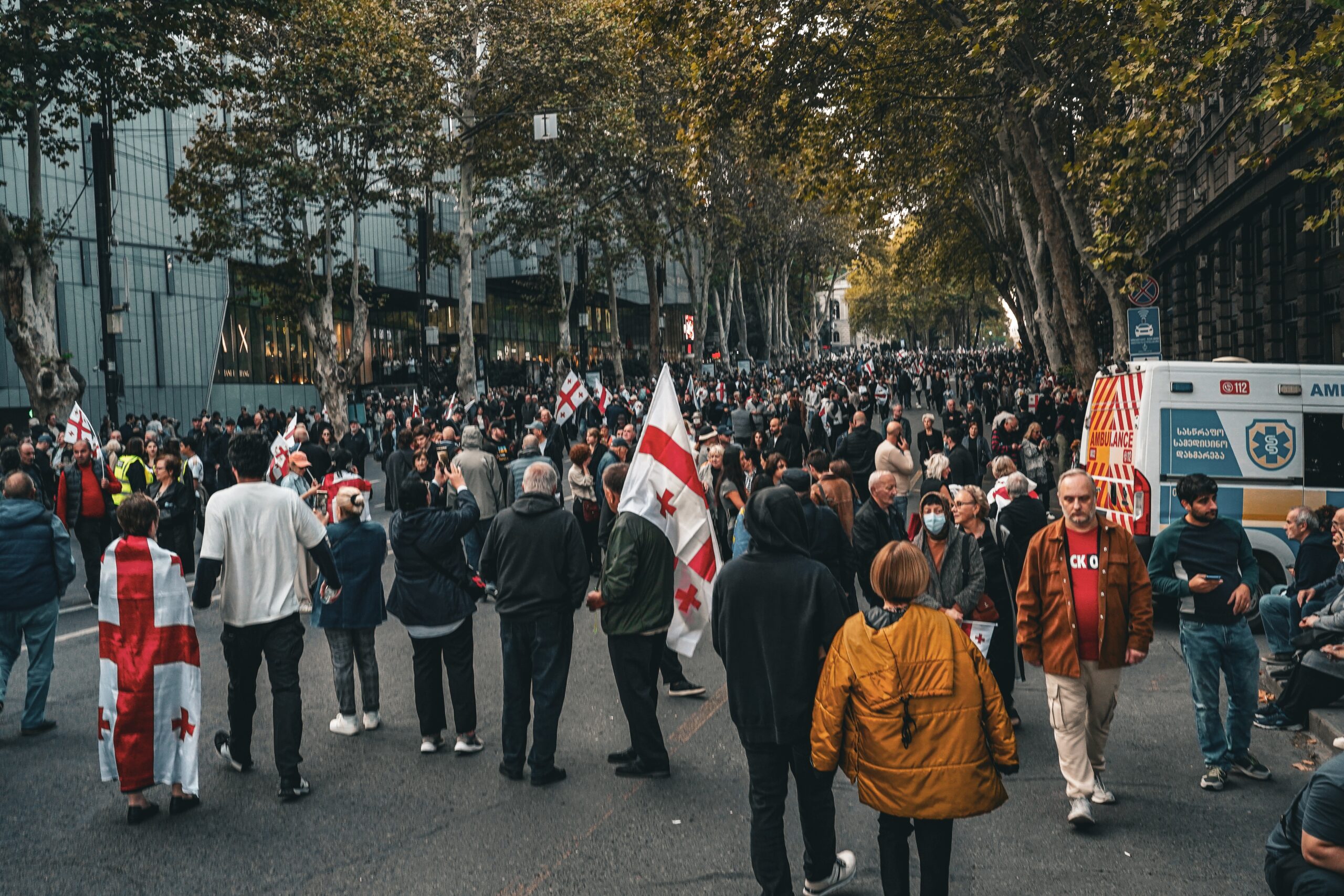
Protests in Bulgaria in 2020
On the evening of December 1st 2025, around 100,000 people filled the central square of the Bulgarian capital, Sofia, to protest against the current coalition government. Massive protests were also happening in Plovdiv, Varna, Burgas, as well as in many of the smaller towns across the country. Although the rallies were formally organized by the pro-European opposition parties to protest the ruling coalition’s plans for the 2026 state budget, they quickly swelled around a deeper frustration: years of popular resentment over corruption and lack of reforms. Bulgaria has long been the EU’s poorest member and ranks second-lowest on the anti-corruption index, just behind Hungary.
The current protests follow a spiral of public discontent and political scandals dating back to the spring of 2025. In April, a public-transport strike in Sofia – organized by union structures seen as close to the governing coalition — was widely interpreted as a politically-motivated attempt to undermine the city’s mayor, Vasil Terziev; partly because he had refused cooperation with figures such as the politician/oligarch Delyan Peevski. Terziev called the strike a “political attack”, prompting a large demonstration in his support.
Analysts argue the move against Terziev was part of broader pressure placed on mayors across Bulgaria who declined to align themselves with Peevski’s expanding political–economic network. Meanwhile, through his party structures, Peevski spent 2025 systematically consolidating influence among local leaders, “welcoming” numerous mayors into his regional-development platform in what critics describe as an exchange of support for loyalty. This dynamic culminated in the arrest of Varna’s mayor, Blagomir Kotsev, on what the opposition denounced as fabricated corruption charges — an event which triggered large protests in both Varna and Sofia. After spending five months in custody, Kotsev was released on bail for 100,000 euros, an extraordinarily high sum by Bulgarian standards and virtually unheard-of in similar cases.
Meanwhile, in order to fuel anti-EU sentiment, pro-Russian circles in Bulgarian politics have driven a parallel wave of protests opposing Bulgaria’s planned adoption of the euro from 2026. One such demonstration in February in Sofia escalated into violence, leaving police officers injured and involving members of parliament from the pro-Russian “Revival” party. State prosecutors sought to remove the MPs’ parliamentary immunity in order to pursue charges related to vandalism and assault, but the ruling coalition declined to support the motion — effectively shielding the deputies from prosecution and further inflaming public frustration.
Revival and the pro-Russian president, Rumen Radev, initially tried to join the December protest wave and support the public demands, but did not see much love from the overwhelmingly pro-European crowds. One way Bulgarian society pushed back against the propaganda pressure from Moscow and its proxies in Sofia was through the widespread attention garnered by the documentary film Architects of Chaos, which exposed the networks and techniques behind large-scale disinformation campaigns. The film reached millions of viewers, and helped citizens — especially younger audiences — recognize and resist manipulation.
In a similar trend to what we are seeing in the current mass protests in Georgia and Serbia, Gen-Z, the youth of Bulgaria, is widely seen as having a significant role in the demonstrations in Sofia and elsewhere. Young Bulgarians, angry and frustrated from years of corruption, political stagnation and democratic backsliding — have led the mass protests. Their demonstrations, marked by a more hopeful, confident tone than previous protest waves, signalled a generational push for deeper reforms rather than just a change of government. Many participants described a sense of renewed civic power and a belief that collective action can force accountability from the state, thereby raising expectations that this momentum could fuel broader political change in the months ahead.
What’s next?
Although the controversial budget proposal was withdrawn, the protesters remained unsatisfied, now calling for the government’s full resignation and early elections. The next wave of demonstrations is scheduled for December 10th, coinciding with a confidence vote in the Bulgarian parliament. Organizers plan to be especially vigilant to prevent a repeat of last week’s clashes, when masked men dress in all black — with alleged ties to the authorities — provoked police and sparked violent disorder in Sofia. This echoes similar patterns seen in Serbia and Georgia, where violent pro-government groups have been deployed against demonstrators with the assistance of the police.
What is unfolding in Bulgaria feels less like a passing surge of discontent and more like a loud turning point, maybe even a revolution. The demands rising from the streets and the vast amount of people in the demonstrations point towards the need for a deeper public renegotiation of how state power should work, how rule of law is structured and observed, and what citizens expect from their government.
— Aleksandar Malinov, Freelance Journalist and Analyst

Help us reach the goal of 400 members by the end of the year! As a member of New Eastern Europe, you will enjoy unlimited access to premium articles, our full archive, downloadable PDF issues, and our podcast. Choose digital-only or add print delivery, and join a community that values independent, in-depth analysis.
Learn AI in 5 minutes a day

This is the easiest way for a busy person wanting to learn AI in as little time as possible:
Sign up for The Rundown AI newsletter
They send you 5-minute email updates on the latest AI news and how to use it
You learn how to become 2x more productive by leveraging AI
QUIZ OF THE WEEK
With the 2026 World Cup draw wrapped up last Friday and North America gearing up to host, we thought we would turn the spotlight to Eastern Europe. Can you keep up with the region’s football history?
This Eastern European goalkeeper remains the only one in history to win the Ballon d’Or. Who is he?
Which Eastern European nation shocked the world by reaching the semi-finals of the 1994 World Cup with a run of spectacular attacking football?
Which Eastern European team made its World Cup debut in 2006, and reached the quarter-finals on its very first attempt?
OPPORTUNITIES OF THE WEEK
Bloomsbury Intelligence and Security Institute (BISI) — Lessons from Ukraine for Western Strategy (Dec 10, 2025) — A high-level dialogue bringing together Ukrainian and Western policymakers, experts, and practitioners to examine how Ukraine’s wartime experience can inform Western preparedness across information warfare, critical infrastructure protection, and economic resilience. Featuring panels on propaganda and societal resilience, security risks to national infrastructure, and wartime economic strategy, plus a special One Decision Podcast session with Sir Richard Dearlove and Kate McCann. Hosted in partnership with KDSP, the Centre for Defence Studies, the NATO Defense College Foundation, and the Kyiv School of Economics. Free registration; limited seats.
The European Correspondent — Polish Editors (from Feb 1, 2026) — A new opportunity to join the rollout of the Polish-language edition as part of The European Correspondent’s multilingual expansion. Two part-time editors (10 days/month each) will lead the Polish edition’s voice, translating and adapting newsletters, social content, and video scripts, and shaping engagement strategies for Polish readers. The role involves maintaining a consistent editorial tone, enhancing accessibility and reader relevance, and contributing to a cross-European newsroom connecting audiences across the continent. Applicants should have prior experience in a Polish media outlet, strong knowledge of the Polish media landscape, and demonstrated skills in translating journalistic content. Native Polish and excellent English are required; additional European languages are welcomed. Candidates must be registered freelancers in an EU country and comfortable working collaboratively in a fast-growing, mission-driven media start-up. Applications are reviewed on a rolling basis.
ARTICLES OF THE WEEK
CARTOON OF THE WEEK

Do you want to see more of Andrzej’s drawings? Check out our dedicated gallery page featuring his cartoons here.